
Jamie Goode: Zero-alcohol wine has a problem – it doesn’t taste like wine
By Jamie Goode, 5 October 2026
-
Share:


1
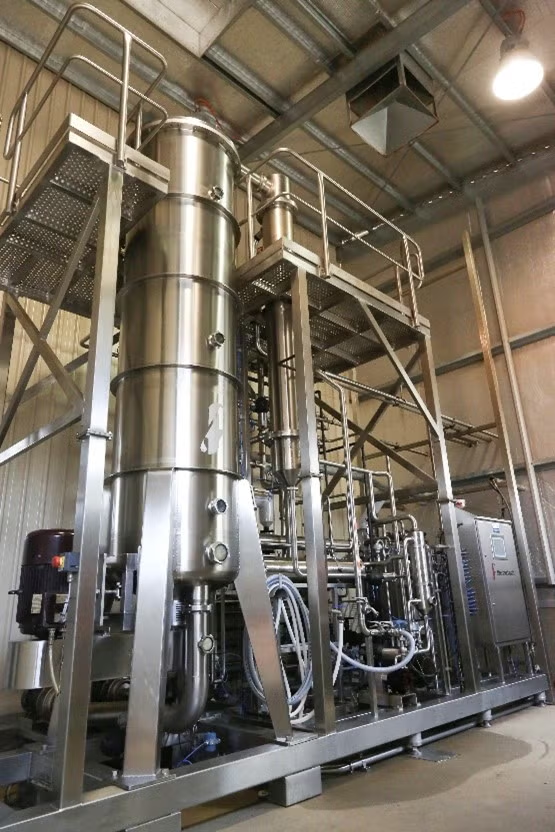
A few years back (2009) I was enlisted by a wine company specializing in lower alcohol wines, for me to give them some market support. As someone with a technical background, but also a consumer-focused newspaper column, I was potentially useful to them. The owner was a Brit based in California who had worked with the spinning cone, a high-tech way of removing alcohol from wine. He was interesting to work with, although he did have an alarming habit of losing his temper in meetings and slamming his forearm down on the table with more force than was strictly necessary.
I liked the idea. It wasn’t zero-alcohol wine, but wines at perhaps 8% or 5% alcohol, with the proper flavour of wine but less booziness. And with the spinning cone column, they were well placed to make these wines, and benefit from others who saw a market opportunity here.
So after some activity in the UK, I flew to their headquarters in California, where I saw the spinning cone in action, and tasted some of their products. Particularly informative was a tasting where we looked at the same wine at different alcohol levels.
The idea was to start with a wine such as a Chardonnay at 14% alcohol. You take 10 000 litres, which you put through the spinning cone, taking off first the volatile fraction (‘essence’) and then the alcohol, leaving you with 8 250 litres of Chardonnay at 4% alcohol. You then add the aromatic ‘essence’ back in, and the resulting 4% wine can be used as a blending component to add to untreated wine, to result in a final wine at a lower alcohol level.
How did the wines taste? I started off looking at a Californian Chardonnay at 14.3% alcohol. It had a sweet, ripe, slightly buttery nose, leading to a rich buttery palate that was quite broad. I then tasted the same wine after it had been through the spinning cone column, at 4% alcohol. This was more minerally with tangerine notes and some spicy richness. The palate was lemony and tart with hollow fruit and an enhanced sensation of acidity. Their winemaker told me that alcohol is a masking agent so taking it away reveals what’s there. It also adds sweetness to the palate. Also, the acidity is concentrated, and appears higher up in the mix. I guess what this showed is that it really matters what you start off with, when you start taking alcohol out. But also that it has a huge effect on flavour.
The next wine was a blend of 10% of the 4% sample with the remainder of the original wine, resulting in a Chardonnay at 13.2%. This was fresher than the original with more acidity apparent. The fruit showed through more. There was quite a difference, and the 13.2% wine was much nicer than the 14.3% original.
I then tried four different Californian wines each at three alcohol levels: the original level, and then reduced levels of 11% and 8%. A Chardonnay that tasted sweet and buttery at 14% alcohol tasted fresher with nice definition at 11%, and then more lemony and refreshing at 8%. A rosé showed best at 12.2%, and was perhaps less successful at 8%. A Shiraz was sweet, juicy and spicy at 14.6%, but fresher and more vivid with less sweetness at 11%; at 8% it was more savoury with fresh, pure fruit and a more gastronomic character. A Merlot showed really well at 11% and fresh, juicy and bracing with more apparent acidity at 8%. These are inexpensive wines, but with this alcohol reduction they really showed very well.
What was immediately apparent was the role that alcohol has in shaping the flavour and aroma of the wine. Take just a little out, and you have a different wine. But in the region of 8% alcohol and above, you can make some very interesting wines, depending on your starting wine.
But my experience of zero alcohol wine has been quite different. Remove it all, and you have something that really doesn’t taste all that wine like at all. This is for three reasons. First, the alcohol itself is contributing something important to the flavour. It adds some sweetness and richness, and quite a lot of the body. And second, alcohol is acting as a masking agent. We like wines the way they taste, but without alcohol and its masking, suddenly you reveal all sorts of aromas that you didn’t see before. And it smells and tastes different, and a bit weird.
It’s not possible to neatly take off all the aroma compounds in one fraction, then take off the alcohol in a second, and then combine back the aroma compounds. This is because many of the desirable aroma compounds leave in the alcohol stream. The evidence in the scientific literature shows that many of the interesting aroma compounds are lost in the dealcoholization process.
Also, there are significant changes in acidity. For example, one study showed that a white wine where the original level was 6.88 g/L rose to 10.05 g/L in the dealcoholized wine and pH lowers with this from 3.00 to 2.70). This is taking these parameters out of the normal range for table wines.
With much more work on technology, it may be possible to preserve more of the aroma molecules in the wine than is currently possible. But this won’t overcome the second, larger problem faced by non-alcoholic wines – the importance of the non-volatile matrix on aroma release.
But for now, it seems that eliminating alcohol changes so much in a wine that it’s very hard to end up with anything that tastes like wine. For most zero-alcohol wines, it’s normal to add sugar at a level of around 40 g/litre, and the resulting wine doesn’t taste sweet, largely because of the sky-high acidity. But this sort of ultraprocessed wine is sort of at odds with where we are heading in terms of gastronomy at the moment.
I remain optimistic about wines that have just a little alcohol reduced, though. Going from 15% to 12% might be a good thing, or going from 13% to 10%, especially for more commercial styles. Sometimes, picking earlier does this job without intervention. But I’m open to some intervention if the results are good.
- Jamie Goode is a London-based wine writer, lecturer, wine judge and book author. With a PhD in plant biology, he worked as a science editor, before starting wineanorak.com, one of the world’s most popular wine websites.
-
Share:

Related articles
Opinion & Analysis
Jamie Goode: Old vines won’t survive on sentiment alone
3 September 2026
Wine has been going through some changes. It has always been going through changes, to be honest. In classic wine-producing regions, we’ve had a long shift from the need for...
Opinion & Analysis
Jamie Goode: Can terroir survive climate change?
3 August 2026
There’s a lot of discussion about the change in climate. Currently, in the UK, we are in the middle of the hottest summer ever, and the last hottest summer ever...
Opinion & Analysis
Jamie Goode: Tasting notes – do they matter?
9 July 2026
I’ve recently been exploring speciality coffee, and took a trip to Brazil to see the coffee harvest, and observe how the cherries are processed. I also did a cupping session,...
Rachel Martin | 5 October 2026
Try wines dealcoholized by Solos—a much improved technology compared to the spinning cone column.