
Jamie Goode: Tasting notes – do they matter?
By Jamie Goode, 9 July 2026
-
Share:





4
I’ve recently been exploring speciality coffee, and took a trip to Brazil to see the coffee harvest, and observe how the cherries are processed. I also did a cupping session, where professionals evaluate different coffees. They score, too: anything scoring over 80 is considered speciality coffee. But one thing I’ve noticed is that in communicating the character of coffee to consumers, it’s very normal just to use three descriptors. That’s it.
I quite like this sawn-off shotgun of a tasting note. Maybe we could try this with wine? In the wine business, tasting notes are usually much longer than three words, and are sometimes a subject of some derision.
It turns out that it’s very difficult to describe the sensation we experience when tasting wine in words. It’s also quite an abstract thing to do. To borrow the famous phrase first applied to music, but which works equally well for wine, writing about wine is like dancing about architecture. Taking the realm of a conscious perception that is created when we put wine into our mouths into the realm of language is quite a perilous journey.
That’s because we have a diminished vocabulary when it comes to the proximal senses of taste and smell. We just find it hard to come up with words for our experiences.
We also have to bear in mind the way that we actually smell things. At the receptor level, a set of around 300-400 different olfactory receptors recognize a far greater number of odorants. They each bind to a range of smell chemicals (odorants), which means they have diverse tuning. The length of time that binding happens for and also the strength of the bond must be coded for. This information then all gets processed, and we identify patterns of activation as olfactory objects. Thus we might smell coffee: this is a varying collection of up to 800 odorants that we have learned to recognize. It’s like in vision, when we see an object like a car or dog and recognize them immediately even if we’ve not seen that particular car or dog before.
Because olfaction is object based like this, we often aren’t able to recognize or identify the component smells of that object. We recognize the whole as a pattern that leads us to identify this particular object. But to tease out the individual component odorant molecules is hard if not impossible. Studies have shown that we are not really able to identify component aromas in mixtures when there are more than four combined.
This is one of the reasons that, when faced with a glass of wine, we hunt for descriptors. Anyone who has studied wine via the Wine and Spirit Education Trust (WSET) will have learned to taste in a specific, reductionistic way using the SAT system (Standard Approach to Tasting). It’s as good as it gets in this way of learning, but it’s very hard to do in practice, because we don’t have access to the raw information from our sensory systems pre-processing. The brain joins all the sensory information up beautifully, filters out the unnecessary stuff, and then presents it to us as a single, unified perception. And then when we taste wine using the SAT, we are attempting to break all this down, and effectively go back to an earlier processing stage that we don’t have access to.
But tasting notes are needed in the wine trade. I write them all the time, and despite the difficulty of doing this well, I would like to think that sometimes at least I manage to capture the wine in words. But it is so unsatisfying, because there is no way to be precise and accurate to the level I’d like my notes to be.
Tasting notes for wine are a relatively recent thing. Steven Shapin has written extensively about wine speak, and his work is worth looking up. Back in the day, most communication about wine was largely about its soundness. Was it good, or was it flawed? There was a lot of wine adulteration around, as well as faulty wine, and this was also a part of the conversation.
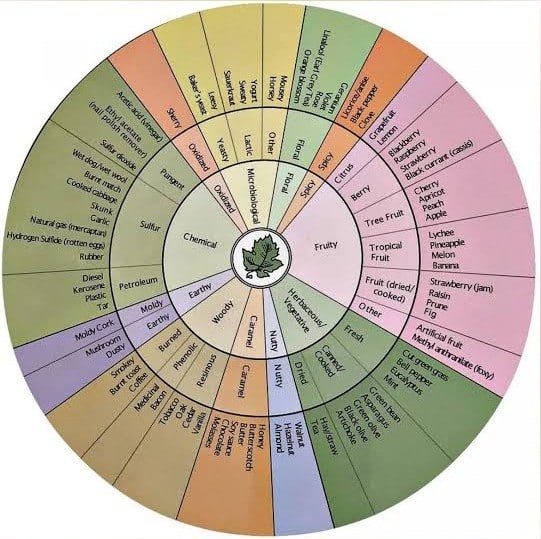
Modern tasting notes began in the 1970s, when researchers at University of California Davis were tired of the imprecise, woolly ways that wines were being described, and wanted a more rigorous language. In 1976, Maynard Amerine and Edward Roessler published a manual for the sensory evaluation of wines. Their goal was to replace vague and fanciful wine terms with a set of more precise words, shifting from the likes of ‘masculine’, ‘naive’, ‘harmonious’ and ‘presumptuous’ to a standardized vocabulary that was more analytic in nature. This work was followed up by a major step forward in moving wine speak in a more scientific, rigorous direction with the development of Noble’s Wine Aroma Wheel. It consists of three concentric rings designating wine smells, beginning with broad olfactory categories in the centre (such as woody, earthy, floral, herbaceous) and gradually getting more specific, with subcategories and then actual smells on the outside. This was an attempt to get past the obstacle that most tasters face when they first try to describe wine: recognizing smells and putting them into words. The aroma wheel equipped students of wine with a lexicon that empowered them to begin tasting in a way that seemed more objective and repeatable. Suddenly, even if we didn’t quite fully have objectivity, we had the impression of objectivity.
Then along came Robert Parker, with his enthusiastic, glowing descriptions of wines. You could sense his enthusiasm for the wines that he liked, and this way of talking about wines has certainly influenced many.
What does a good tasting note look like? I think tasting notes can have different objectives. Is this a note on a wine list to help customers choose the right wine? Or is it a note made in the process of professional criticism to go with a score out of 100? Or is this a note made just for the tasters’ benefit, perhaps to be consulted later when making buying decisions? More broadly, is this a note that’s B2B, or B2C (for other trade, or for consumers)?
Irrespective of the function of the tasting note, my view is that the ideal verbal description of a wine is one that allows another person to recognize that wine. Take the following scenario. You are sitting across me, with a physical divider between us so that you can’t see me, but you can hear me. We both have five roughly similar wines in front of us but in randomized order. If you are to describe your wines one by one in words, then if I am able to match mine to yours, then you have done a great job with your tasting note.
Too often, tasting notes have some element of describing what is in the glass, but this is supplemented by top-down knowledge and templating. You decide what a wine is then use your knowledge of that wine style and the words you have in your head to describe the wine with. It’s not a pure process. And very often people embellish their notes with verbal flourishes. The final note sounds great, but doesn’t necessarily accurately describe what is in the glass. We are so used to writing notes like this, we don’t realize what we are doing.
And this is without even referencing the strong cultural element of using local descriptors for wines that may not be present in other cultures, thus rendering tasting notes local in their utility.
Maybe we should dial back our notes a bit. Use fewer but better chosen descriptors. Try to describe what is in the glass, but balance out reductionist approaches with more holistic approaches where we try to capture the nature of the wine using figurative language. I’d be up for this.
- Jamie Goode is a London-based wine writer, lecturer, wine judge and book author. With a PhD in plant biology, he worked as a science editor, before starting wineanorak.com, one of the world’s most popular wine websites.
-
Share:

Related articles
Opinion & Analysis
Jamie Goode: Zero-alcohol wine has a problem – it doesn’t taste like wine
5 October 2026
A few years back (2009) I was enlisted by a wine company specializing in lower alcohol wines, for me to give them some market support. As someone with a technical...
1
Opinion & Analysis
Jamie Goode: Old vines won’t survive on sentiment alone
3 September 2026
Wine has been going through some changes. It has always been going through changes, to be honest. In classic wine-producing regions, we’ve had a long shift from the need for...
Opinion & Analysis
Jamie Goode: Can terroir survive climate change?
3 August 2026
There’s a lot of discussion about the change in climate. Currently, in the UK, we are in the middle of the hottest summer ever, and the last hottest summer ever...
Tibi | 18 July 2026
Totally agree. We should emphasize more on the object based tasting notes, like it’s a car, or a dog. A wine is much more than the sum of all identifyable aromas, we shoul focus more on object based descriptions.
I often compare tasting to reading. We cannot understand your article or a book by enumerating all the letters it contains. Focusing on the words starts to give us some ideas, but entire sentences provide meaning.
However, without learning the letters, and learning to put them together, understanding sentences is impossible. That’s why I still consider WSET highly relevant. BTW, it’s Systematic not Standard approach of tasting.
Michael Donohue | 21 July 2026
The S is for systematic, not standard, tasting approach. The WSET police have been notified!
Michael Donohue | 21 July 2026
What precisely are the 3 descriptors used by coffee experts? I’m guessing robust is one.
Jamie Johnson | 22 July 2026
With high-end specialty coffee, similar with single-vineyard minimal intervention wines their goal is more to reflect origin, variety, processing method, and terroir more than the roast. Any toasty notes are often seen as negative similar with too much oak or over extraction in wine. The most prized coffees tend to be the lightest roasted Geishas and some of the prices from auction lots from the top farms in Panama like Esmeralda can be eye-watering. I have unfortunately not been able to find any South African coffee roasters that roast light enough for my personal preference compared with the top European, Canadian & Chinese roasters.
To answer your question, with modern speciality light-roast coffee the emphasis has shifted from roast-derived flavours (chocolate, caramel, nuts) toward origin-driven flavours (fruit, florals, tea, and vivid acidity). The descriptors are normally clustered around: citrus, stone fruit, floral, sweetness, berries & tropical fruit. These often help to highlight bright acidity and the transparent character that light roasting aims to preserve.
Obviously some roaster’s descriptors tend to be more accurate than others but once you have an idea of the flavour notes you gravitate towards it can be helpful when choosing coffees from other roasters.